
Elite Proxies
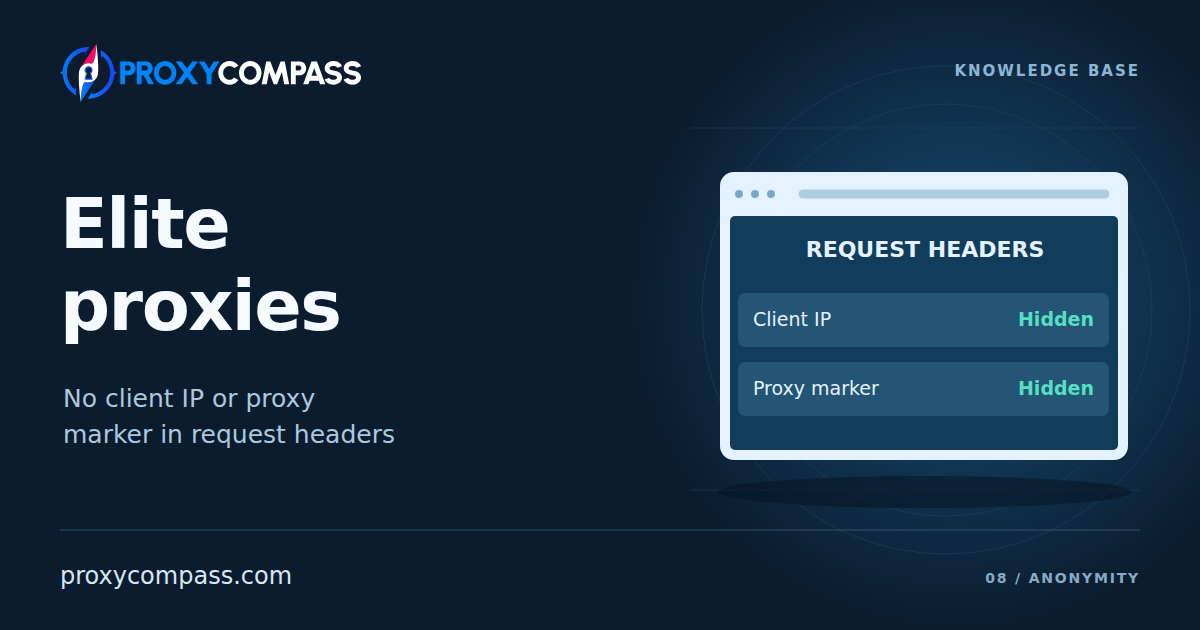
An elite proxy, also called a high anonymity proxy, hides your original IP address and does not add HTTP headers announcing proxy use. For modern commercial proxy services, this is expected behavior. The word “Elite” may sound like a promise of superior quality, but that is not what the label measures.
In the older classification of proxy anonymity levels, Elite describes what the proxy reveals about the connection. It does not grade speed, reliability, or IP reputation. An excellent proxy and a barely usable one can both belong to this class.
What the website receives
Suppose your public IP is 198.51.100.24, and the proxy connects to the website from 203.0.113.80. The website sees the second address. Your original IP is not included in a forwarding header such as X-Forwarded-For, and the proxy adds no explicit intermediary marker such as Via.

The illustration shows an unencrypted HTTP request. With an ordinary HTTPS tunnel established using CONNECT, the request headers are encrypted between the client and website; a relay cannot insert those headers into the encrypted request. Elite itself does not mean the traffic is encrypted: that protection comes from HTTPS.
Why an Elite proxy can be good or bad
Imagine two proxies that both hide the client's original IP and add no revealing headers. One is fast and stable, with a lightly used address and a good reputation. The other is slow, frequently drops connections, and uses an address that has been abused and added to blocklists. Both are still Elite.
Their performance and IP history are separate from this anonymity class. A proxy does not stop being Elite when its server becomes overloaded or its address is blocked. The absence of identifying headers does not erase past abuse, remove the address from blocklists, or make the connection faster.
Elite also does not tell you whether an address is shared or dedicated, static or rotating, or which type of network it belongs to. Those are separate characteristics. To assess quality, check speed, connection stability, and successful requests on the websites you actually need. The Elite label alone does not answer any of these questions.
Why a website can still recognize an Elite proxy
The proxy's own IP remains visible. A website can identify it through a proxy or hosting database, or apply restrictions based on previous activity from that address. It does not need to discover your home IP to reject the connection.
This is why a checker can report Elite while a particular website refuses access. The anonymity test and the website's decision measure different things. Even a fast, reliable Elite proxy is not guaranteed to be accepted everywhere.