
Anonymous Proxies
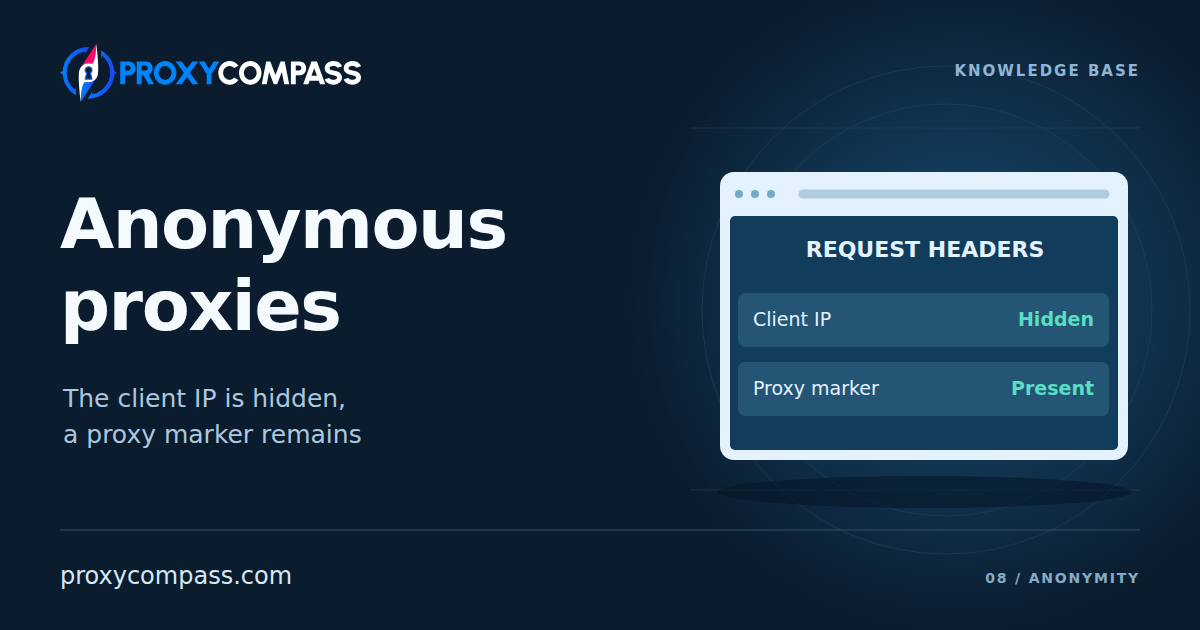
An anonymous proxy hides your original IP address from the website, but leaves signs that the request passed through a proxy. In the traditional HTTP classification, these are two separate properties: the proxy does not forward your address in the request headers, yet it leaves a marker of an intermediary.
This meaning belongs to the older classification of proxy anonymity levels. Modern commercial proxies are expected to behave as Elite / High Anonymity proxies: they hide the client's original IP and do not add headers announcing proxy use. The narrower Anonymous category is mainly useful for reading older descriptions and public proxy lists.
What the website receives
Suppose your public IP is 198.51.100.24, and the proxy connects to the website from 203.0.113.80. The website sees a connection from the second address. Your original IP is not forwarded in the request headers.
However, an unencrypted HTTP request can contain a header such as Via: 1.1 proxy. It records an intermediary that forwarded the request. Here, proxy is an example name for that intermediary; it does not identify you. In this example, the visiting proxy adds the header, revealing proxy use without revealing your original IP. A Via value added by the website's own gateway would instead describe that gateway.

Why a checker can still detect the proxy
“Your IP is hidden” and “Proxy detected” can both be correct. A checker does not need to recover your original address to notice a proxy marker in the request. It is answering two different questions: which IP reached the website, and whether the request shows signs of an intermediary.
A website that rejects requests with such markers may deny access even though your IP is hidden. The presence of a marker does not, by itself, mean every website will block the request.
“Anonymous” in a service description
Outside this classification, “anonymous” often simply means that a proxy hides your IP. A provider may use the word for Elite proxies too. The word in a product description therefore does not necessarily mean that the service forwards a proxy marker. The classification describes header behavior; it says nothing about whether an IP is shared, dedicated, static, or rotating.
Where this classification stops
The example concerns an HTTP request the proxy can read. With an ordinary HTTPS tunnel established using CONNECT, the website request and its headers travel inside an end-to-end TLS connection. A proxy that only relays this encrypted traffic cannot insert Via into those headers.
Hiding an IP from the destination also does not make you unidentifiable to everyone. The proxy operator receives your connection, and a website still knows which account you use when you log in.