
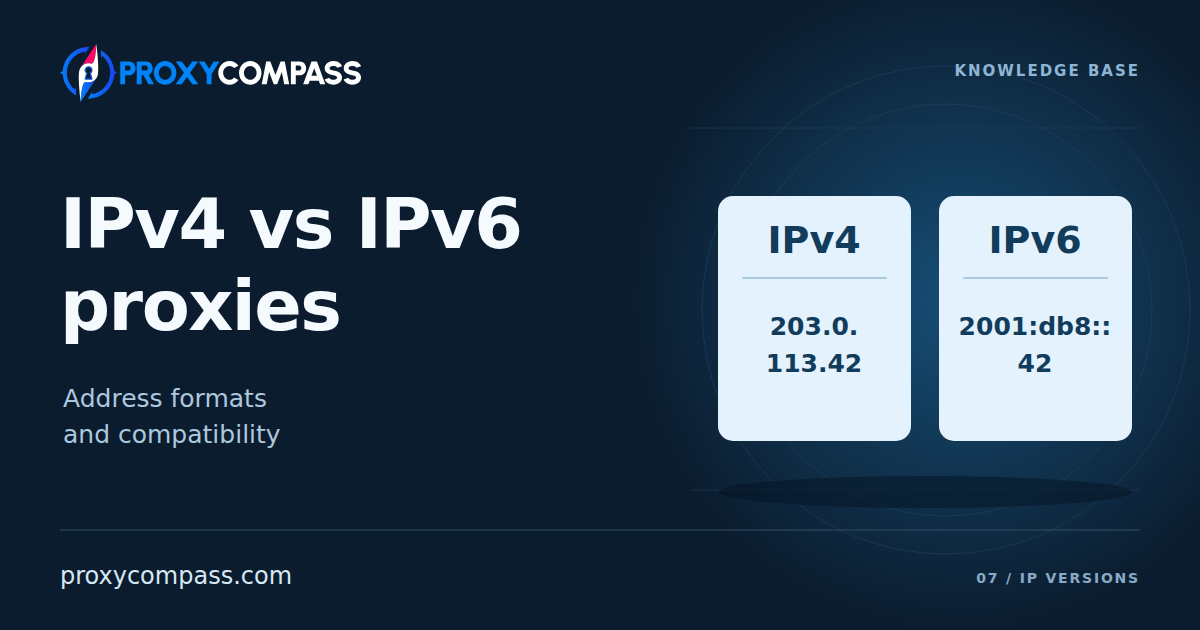
IPv4 vs IPv6 Proxies
An IPv4 proxy contacts websites from an IPv4 address; an IPv6 proxy uses an IPv6 address. These are two versions of the Internet Protocol, which sets the rules for sending data across networks. For a proxy user, the main differences concern which websites the proxy can reach and which addresses are available for the job.
IP version is one part of choosing a proxy. The guide to proxy services covers the other service characteristics. Here, we compare IPv4 and IPv6: why both remain in use, where a large supply of IPv6 addresses is useful, and which tasks still need IPv4.

www.facebook.com and www.google.com accept both IP versions, while www.tiktok.com and www.twitch.tv accept IPv4 only. Support for these hostnames can change, and other hostnames within the same service may behave differently. Check the current addresses and the complete workflow before choosing a proxy.What changes when you choose IPv4 or IPv6?
IPv4: access to websites that do not yet support IPv6
An IPv4 address has a familiar format, such as 203.0.113.42. This version has been in use for decades, and many websites still accept only IPv4 connections. If a job depends on one of those websites, the proxy must be able to reach it over IPv4.
The supply of IPv4 addresses is limited. Providers buy or lease existing addresses and may reassign them to new customers when a subscription ends. A proxy that is new to its buyer can therefore have a history of use. The guide to IPv4 proxies explains the address format, scarcity, and reputation in detail.
IPv6: a large address supply for compatible websites
An IPv6 address is longer and can look like 2001:db8::42. This version has vastly more possible addresses. Providers have more room to assign additional IPs from their ranges, including addresses that have never been used before.
That is useful when many workspaces need their own fixed addresses, or when another task calls for a large address pool. The websites the proxy contacts must accept IPv6. The guide to IPv6 proxies explains how these addresses work and how providers make them available to customers.
| Characteristic | IPv4 proxies | IPv6 proxies |
|---|---|---|
| Direct access to a website | The website must accept IPv4 | The website must accept IPv6 |
| Adding more IPs | Requires more addresses from a limited supply | A large range allows many additional assignments |
| Previously unused IPs | Possible, but buying a new proxy does not mean receiving an unused address | Providers have more room to assign them from unused parts of a range |
| Keeping the same address | Possible with a service that provides a static assignment | Possible on the same terms; IP version alone does not guarantee it |
| Speed and account access | Depend on the network, service quality, and website rules | Depend on the same factors; IPv6 has no automatic advantage |
Why has IPv6 not replaced IPv4?
IPv6 was developed primarily to address the limited supply of IPv4 addresses. It is not a setting that an operator can enable on one server to replace IPv4 throughout the internet. A device using only IPv6 cannot exchange IP packets directly with a device that has only IPv4.
Adoption requires work by internet providers, website operators, and software developers. A website must accept IPv6 connections, its logs must store longer addresses, and its access rules must handle them correctly. Those changes need configuration and testing. Meanwhile, people who still have only IPv4 must retain access to the website.
Many networks and websites therefore support both versions at once. This arrangement is called dual stack. A visitor can connect over either IPv4 or IPv6, and the website can serve both. Translation between versions is also possible, but it depends on the network providing that function. Having an IPv6 address does not add it automatically.
How widely is IPv6 used?
IPv6 is widely used in home and mobile internet access, but adoption differs considerably between countries. It is available to most users in France, India, and Germany. IPv4 still predominates in Spain and Russia.
The table gives one illustrative snapshot of APNIC's measurements: the approximate share of users able to retrieve a test resource available only over IPv6. This estimates IPv6 capability in the measured connections, not the share of all internet traffic or websites using IPv6. The rounded values show the broad differences between countries; they are not a live counter.
| Country | Share of users with IPv6 support |
|---|---|
| France | About 86% |
| India | About 76% |
| Germany | About 73% |
| United States | About 63% |
| Spain | About 11% |
| Russia | About 8% |
These approximate figures come from APNIC Labs. Values change; the linked page provides updated measurements.
These statistics describe IPv6 adoption among users. They do not establish whether a particular website supports IPv6. Low adoption in a country does not prevent work with a compatible social platform through an IPv6 proxy, and high adoption does not guarantee access to every local website.
Compatibility: check the complete workflow
If a website accepts only IPv4, a proxy with only an IPv6 exit cannot contact it directly. Replacing one IPv6 address with another will not help: the website still has no IPv6 address to connect to. The reverse applies to a destination available only over IPv6: direct access requires an IPv6 exit.
An application normally finds a website's address through DNS, the system that connects domain names to addresses. An A record contains an IPv4 address; an AAAA record contains an IPv6 address. An AAAA record helps establish IPv6 support, but does not prove that every required action will work through a particular proxy.
For example, a service's homepage might load over IPv6 while its sign-in page uses another domain that accepts only IPv4. An advertising dashboard might load but send data to a separate destination that is unavailable over IPv6. Test the normal working sequence: signing in, opening the required section, uploading files, publishing content, or retrieving data through an API—the interface used by software.
Your application's connection to the proxy is a separate part of the journey. A provider can supply an IPv4 entry address for a proxy that contacts websites over IPv6. In that setup, your home internet provider does not need to offer IPv6. The proxy service and application must support this arrangement. To check which version reaches a website, examine the connection address seen by that website; the address entered in the proxy settings does not establish it.
Where else are IPv6 proxies useful?
Collecting data from compatible websites and APIs. If all required sources are reachable over IPv6, separate addresses can be assigned to workers or groups of tasks. Compatibility is easier to establish in advance for recurring work with known sources than for a constantly changing list of websites.
Testing your own websites and applications. An IPv6 proxy provides an external network from which to check page loading, sign-in, file uploads, and the handling of long addresses in logs. Confirm that the request actually arrives over IPv6: a service that can also use IPv4 may fall back to it. Comparing the two versions can reveal a problem affecting IPv6 access. This checks the path from the proxy to the website; it does not test your visitor's own internet connection.
Monitoring availability over both versions. A website can have different network routes and access rules for IPv4 and IPv6. Testing only one version will miss a failure affecting the other. Separate checks can reveal that a website is available to only some of its visitors.
A large IP list does not automatically increase a proxy service's capacity. Thousands of addresses can share one server and one network connection. Data volume, simultaneous connections, and processing speed still depend on equipment and service terms.
Speed, anonymity, and network type: what IP version does not determine
IPv6 does not guarantee higher speed. Connections over the two versions can take different routes to the same website. One route may be shorter or less congested, while the other is slower. Proxy server load and the website's response time also affect the result.
For a useful comparison, choose proxies under similar conditions: nearby locations, the same network type, and comparable service limits. Then run the same task in the same application. Completion time, successful requests, and session stability tell you more than one latency measurement against an IP-checking website.
Datacenter, residential, and mobile networks can use either IP version. Switching to IPv6 does not turn a datacenter address into a residential one, change its country, or add more network operators to a pool. A thousand addresses from one network still represent that one network.
Address length does not determine encryption either. The 128 bits in IPv6 describe the address, not an encryption key. HTTPS can protect data sent over IPv4 or IPv6. The IP version alone neither hides proxy use nor makes the user anonymous.
Can you use IPv4 and IPv6 together?
Yes. A team might use static IPv6 proxies for tested social-media work profiles and IPv4 for other services that require it. Different tasks do not have to use the same IP version throughout a company.
There are two ways to arrange this: assign separate IPv4 and IPv6 proxies to different tasks, or choose a service that can contact websites over both versions. With the second option, find out how the proxy chooses a version when opening a connection and whether you can require one version for a test. Sending it a domain name does not, by itself, force IPv6. Automatic switching is not available in every service.
When a proxy contacts a website over IPv4, the website sees an IPv4 address. A provider with millions of IPv6 addresses does not necessarily have millions of IPv4 addresses as well. Switching versions also changes the address the website sees. That matters when a working session or access permission depends on a fixed IP.
Choosing the version for your task
IPv4 is necessary on the path to a website that accepts only IPv4. It is also convenient for projects with large, changing lists of websites: the setup does not have to rely on every source supporting IPv6. Check the two parts of the connection separately: an application's need for an IPv4 address to reach the proxy does not necessarily require the proxy to use IPv4 when contacting websites.
IPv6 fits when the required services and applications support it and the job benefits from a large address supply. Examples include fixed IPs for client projects, data collection from tested sources, and specific checks of IPv6 availability. A website supporting IPv6 does not mean it accepts every IPv6 proxy, so test the actual service you intend to use.
Both versions fit when requirements differ between tasks. Start with the websites, applications, and address behaviour the job requires. Then choose the network type, location, and service quality. The IP version will follow from the work you need to perform.
Why use IPv6 proxies for social media and advertising?
One practical application is managing several client projects within an agency or marketing team. Staff maintain brand pages, publish content, answer messages, use advertising dashboards, and collect reports. Different clients may have separate browser work profiles, each with its own proxy settings.
When a project needs a fixed IP, its work profile can be assigned a static IPv6 proxy. The website then sees the same address on subsequent visits. A new project can receive another IP while existing assignments remain in place. This is useful as the number of projects grows and each workspace needs a stable address of its own.
This is where IPv6's large address space helps. A provider can reserve many addresses for future assignments and keep established profiles on their existing IPs. Some of those addresses may never have been used, but an address available in the provider's pool is not necessarily unused: it may have been released by another customer. The large supply makes new assignments easier without requiring constant rotation.
A low price per IPv6 address can make this arrangement easier to maintain: a team can retain fixed addresses and add more as work grows. Compare the cost of the whole service, including the workload and traffic it allows, rather than assuming every IPv6 offer is cheaper. The reason to choose IPv6 is access to suitable addresses for those projects. If a required advertising dashboard needs an IPv4 connection from the proxy, compatibility takes priority over the price of IPv6.
A previously unused address has no earlier user's activity attached to that individual IP. A website can still consider the reputation of the surrounding range or provider's network. A new IPv6 address from a known hosting network remains part of that network. A service can also consider the account, cookies, browser information, and user activity. A new address therefore does not automatically earn a social platform's trust.
A static address is a service condition, too, rather than a guarantee provided by IPv6. Find out how long the assignment lasts, whether other customers use it at the same time, and whether it remains in place after renewal. Confirming those terms and trying the required actions with a small sample is more useful than judging an offer by its address count alone.