
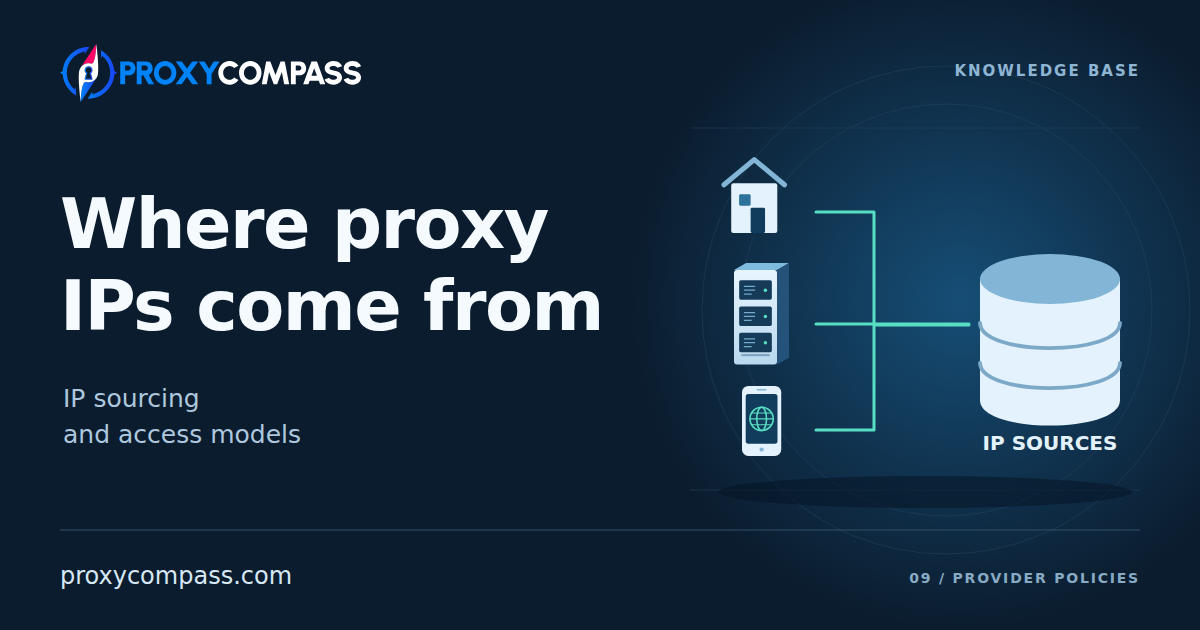
IP Sourcing
A proxy provider may deliver a list of IP addresses or a gateway that selects a proxy server or device for each connection. Behind that access are resources the company has to obtain: address ranges, servers, internet connections and, in some networks, access to other people’s devices. IP sourcing describes how those resources enter the service.
This article explains sourcing across the proxy industry. It is one of the subjects covered by proxy provider policies. The origin of a connection helps explain who controls it, why an address may disappear from a pool and how several sellers can depend on the same supplier. The final section describes the server-based products offered by ProxyCompass.
One proxy service can involve several companies
Consider a provider that rents servers in a data center and obtains an IP range from a separate supplier. It installs proxy software, assigns customer access and handles orders. The company supplying the addresses, the company running the data center and the company selling the proxies each provide a different part of the service.
The name shown in an IP registration record can therefore differ from the brand on the invoice. A proxy seller may use an address range registered to a hosting company or an internet service provider. That arrangement is common when resources are leased or supplied under a commercial agreement.
Operating the proxies also involves more than holding the addresses. Someone must keep the servers online, connect them to the internet, route traffic to the range and manage customer access. A seller can perform these jobs itself or buy a service in which some of them are already handled.
This division becomes visible when something fails. The seller may be able to restart its proxy software immediately, while a connectivity fault requires the data center to act. If access to an entire address range ends, replacing a server alone will not restore it.
How datacenter and ISP addresses become working proxies
One route is to hold an address range registered to the provider’s organization. The company may have received it through an earlier allocation or acquired the registration rights through a recorded transfer. Regional Internet Registries maintain those records and administer transfers under their own rules. Registering a new proxy business does not automatically give it a supply of IPv4 addresses.
Another route is to lease a range. Its holder makes the addresses available for an agreed period, while the proxy provider pays to use them. The provider can use the block for as long as the lease allows. The agreement can be direct or arranged through a supplier that handles address leasing.
A third route is to rent servers with IP addresses included. The hosting company provides the machine, connectivity and addresses together. The proxy provider configures the service on that infrastructure. In other arrangements, it brings a separately obtained range to a hosting company that supports outside address space.

An address list by itself cannot carry a request. The range must be reachable through the network serving the proxy infrastructure. The network operator arranges routing so that replies addressed to those IPs reach the right servers. The proxy software can then open outgoing connections using addresses from the range. Routing and permission to use the range are handled between the organizations supplying these resources.
For example, the same server can keep running while the provider changes the range connected to it. Conversely, a provider may move an address range to different compatible infrastructure while keeping the addresses. Whether either change is possible depends on the supply agreement and network arrangements.
ISP proxies use addresses associated with an internet service provider. In a common commercial model, the proxy software runs on continuously operated servers in a data center. The operator’s address range is made available to that infrastructure, directly or through a supplier. A household computer does not have to stay switched on for this model to work.
Obtaining a particular operator’s addresses requires access to that operator’s resources or to a supplier already able to provide them. This helps explain why ISP proxies may be available in a smaller selection of countries or networks than a seller’s datacenter products. Adding a country to a dashboard cannot create the required supply.
An IP lease also has an end date and conditions. If the provider loses access to the leased range, it may have to replace customers’ IP lists even though its servers are healthy. When the provider controls the range independently of its hosting arrangement, it may have more options for moving the service. In either case, maintaining the addresses is part of operating the product.
How a home connection enters a residential pool
In a device-based residential network, the internet provider continues to supply the participant’s home connection. The proxy company obtains access to that connection through software running on a device. It can then direct a customer request to the device, which opens the connection to the destination website. The website sees the public IP used by that household connection.

One recruitment method is a bandwidth-sharing application. A person installs it specifically to receive compensation for making some of their connection available. The network operator pays under the program’s rules. Earnings can depend on demand for that location, how long the device is available or how much it is used; there is no single payment model for all networks.
Another method uses a software development kit, usually shortened to SDK. Here it means a module that a developer adds to an existing game, utility or other application. The module handles participation in the proxy network while the application continues to perform its ordinary function.
With this model, the developer can receive payment from the network operator. The user might receive an application feature, fewer advertisements or another benefit in exchange for joining. Money paid to the developer and compensation offered to the user are separate parts of the arrangement. Installing an application with an SDK is also different from deliberately installing a bandwidth-sharing app: the proxy function may be secondary to the reason the person wanted the software.
Traffic uses the participant’s connection and some of the device’s resources. The network needs rules for when the module can run and how much bandwidth or processing capacity it may consume. Those rules affect the supply available to proxy customers: a device might participate only while the application is running or when its resource conditions are met.
The participant can also close the application, turn off the computer, lose connectivity or leave the program. The provider can choose another available device, but it cannot continue using a disconnected device. This is why retaining a residential IP depends on the continued availability of the connection supplying it, even when the customer has requested a sticky session.
Two sources of mobile proxy connections
A mobile proxy needs an outgoing connection through a cellular operator. One way to obtain it is through a participant’s smartphone running an application or SDK. The device supplies the cellular connection while the proxy network coordinates customer access. Availability depends on the phone, the software, signal conditions and the owner’s actions.
The connection actually used by the phone matters. If proxy traffic leaves through home Wi-Fi, the website sees the home internet connection’s address. A phone supplies a mobile proxy connection when that traffic uses its cellular network.

The other model uses equipment managed by the provider or its partner: modems, cellular routers or phones fitted with SIM cards. The equipment is kept powered and connected to management software. Customers may rent access to a particular modem or use a pool of these devices. The operator of the equipment can maintain it and arrange reconnections without waiting for an unrelated user to open an app.
The cellular operator still supplies the connection and assigns its network addresses. Signal, local load, the data plan and operator restrictions affect the service. Reconnecting a modem can produce a different public IP, but a new address on every attempt is not guaranteed. The proxy company cannot choose an arbitrary address outside the supply available through the operator.
A dedicated modem can also use a public IP shared with other subscribers. Cellular networks can place several subscribers behind carrier-grade NAT, or CGNAT, which translates their connections through a shared public address. Renting the modem gives control over that piece of equipment; it does not give the proxy seller control over how the mobile operator shares its public IPv4 addresses.
Does the device owner know they are supplying a proxy?
For a participant, joining a proxy network means allowing other customers’ connections to pass through their device and internet access. A meaningful choice requires that this function be explained before it starts. The person needs to understand what is being shared, what they receive in return and how to stop participating.
A visible participation switch and an effective way to leave serve a practical purpose. Someone who wants to keep using a game or utility should be able to understand whether its proxy function is enabled. The network must also honor withdrawal: a device that has stopped participating is no longer an available source of connections.
Permission to install software and permission to share a network can involve different people. A personally owned laptop may be connected to an employer’s or hotel’s internet service. Some bandwidth-sharing programs explicitly require the participant to have authority to share that connection and to comply with the internet service agreement.
Hidden enrollment creates a different situation. An application can perform its advertised job while quietly forwarding third-party traffic. Malware can also turn a compromised device into a proxy. The address seen by the website can still be an ordinary household address, because the traffic really passes through that household’s connection.
This has been documented in actual networks. In its January 2026 investigation of IPIDEA, Google Threat Intelligence Group described applications that enrolled devices without clearly disclosing the proxy function. Google reported taking action against the network’s control domains and adding protections against applications containing the identified software modules. This example shows how a seller’s supply can depend on software installed on devices whose owners did not knowingly agree to provide that service.
Different sellers can draw from the same pool
A provider does not have to recruit every participant or operate every proxy server or device itself. It can buy access to a wholesale network and sell that access through its own website, billing system and gateway. Another company may manage the devices and the connections to destination websites.
A seller can also combine sources: some servers or participants it manages directly, plus additional capacity obtained from partners. The customer sees one account, even though the available connections come from several suppliers. These arrangements can expand coverage without requiring the seller to build an operation in every country.
The reverse is possible too: several sellers may buy access from the same supplier. A customer switching brands can therefore encounter some of the same proxy IPs. A problem at that shared supplier can affect both services, so separate invoices do not necessarily mean separate infrastructure.
The same IP appearing at two services does not, on its own, reveal the commercial arrangement. There might be a shared supplier, more than one proxy application on a device or several devices using one public address. Pool overlap is an observable result; the exact relationship between the sellers requires additional information.
Pool size also depends on how addresses are counted. A figure can describe unique IPs observed during a month, devices enrolled over the network’s lifetime or IP addresses available at a particular moment. These are different quantities. One device can contribute several IPs as its connection changes, while multiple devices can share a single public IP.
A large total therefore does not mean that all of those addresses can be used at once. Only part of the network may be online, and a country or operator selection narrows it further. The supply available to a task comes from the connections that are usable under those conditions at that time.