
Static vs Rotating Proxies
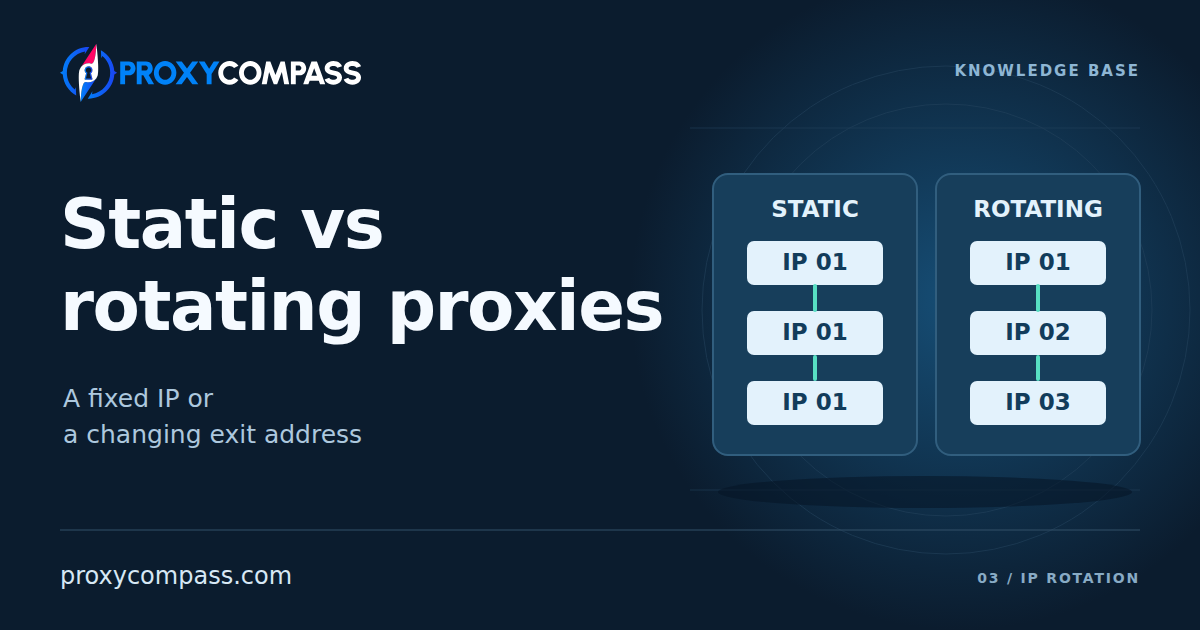
Static proxies provide assigned exit IPs that you can use again on later connections. With rotating proxies, the service selects an exit according to its rotation rules. The exit IP is the address from which your connection reaches the website. It may differ from the gateway address entered in your software.
Choose according to how long your task needs the same address. Access to a server may require the exact IP again tomorrow. A short browser test may need one IP only until its steps finish. Independent page checks may allow a different exit for each operation. Both options fit within the wider picture explained in the proxy guide.
How static and rotating proxies work
With a static proxy, your application connects through an assigned exit address, and the website sees that address as the source. If you use the same proxy for the next connection, the exit IP stays the same while its assignment remains valid. A static package can include several addresses; your application decides which proxy to use for each task.
With a rotating service, your application connects to a gateway, and the service selects an available exit from its pool. When its rotation rules call for a new selection, the next connection may use a different exit IP. The gateway in your settings can stay the same while the website sees a different source address. A pool can also return an address that has already been used.

The connection settings do not always reveal how the exit is selected. A static service can also use gateway ports mapped to fixed exits. A rotating service may offer filters, such as a country setting. A supported country filter selects a suitable exit there; it usually does not let you choose an exact IP.
This separates two kinds of control: choosing a particular address and choosing the conditions an address must meet. A large pool can offer many candidates without giving you a permanent list of them. A small static package can give you direct control over each assigned address. The relationship between the entrance and the available exits is explained in IP Pools & Gateway Endpoints.
Static and rotating proxies side by side
| Question | Static proxies | Rotating proxies |
|---|---|---|
| What do you receive? | Access to particular assigned exit IPs. | Access to exits selected from a pool under the service's rules. |
| Can you return to a known IP later? | Yes, while that address remains assigned to your package. | A sticky session may retain it temporarily. Once the assignment ends, you generally cannot request that exact IP again. |
| How does the address change? | Your software selects another proxy from the list, or the service replaces an assigned IP. | The service selects an exit again according to a request, timer or command. |
| How do several steps keep one IP? | They continue through the same assigned proxy. | They use an active sticky assignment where that mode is supported. |
| Who manages the selection of exits? | You allocate entries from your list to tasks; the provider maintains the proxies. | The service selects from the available pool; you control the supported routing and session settings. |
These terms describe whether an exit address stays the same. They do not specify its network type or whether other customers share it. Datacenter, ISP, residential and mobile services can offer different assignment and rotation options. A mobile connection, for example, may retain an IP only while the carrier keeps it assigned. Check the actual retention terms: a stable address is not necessarily dedicated, and a rotating address is not necessarily residential.
When a fixed address is useful
The clearest case is access to a destination that permits specific source IPs. If an administrator adds your proxy's exit IP to a server's allowlist, future connections must arrive from that address. Another working proxy in the same country will still fail that rule. A lasting assignment avoids having to update the allowlist whenever a short session ends.
Fixed addresses also help with work that returns to the same systems over days or weeks. An authorised business account or a recurring API job can keep a consistent network address between runs. This removes repeated IP changes from the workflow, although the website still applies its own authentication and security checks.
A known list is useful for repeatable measurements and troubleshooting. A monitoring process can keep the same exit while comparing results over time, and its logs can identify exactly which proxy produced a response. If one assigned address needs attention, you can investigate or replace that entry without changing the rest of the list.
Long-term continuity depends on the assignment terms. A static IP can still be replaced because of maintenance, a scheduled refresh or a change in the provider's address supply. When a setup relies on the same IP after renewal, the relevant question is whether that assignment continues. The word static alone does not promise permanent ownership or uninterrupted service.

When a rotating pool is useful
A rotating pool suits work made up of independent operations. A monitor collecting separate public product pages, for example, may not need the first and last lookup to use the same IP. Distributing those lookups across available exits can avoid placing the whole workload on a single address, while the service handles the selection.
The benefit becomes clearer when the required selection is larger or more varied than a fixed list you want to maintain. Where location filters are available, a regional website test can request suitable exits for each location instead of managing individual proxy records there. This requires actual coverage in the selected locations; a worldwide pool total does not establish the choice available to one account or filter.
Service-managed selection reduces the work of choosing individual exits, but also gives you less certainty about the next address. A new selection can return an IP seen earlier. Some members of the pool may be unavailable, and a narrower filter may leave only a small group. Rotating access is useful when the job can accept a suitable available address, rather than requiring a specific one from an earlier run.
It is also possible to rotate through a static list. Your software can assign the first proxy to one task, the second to the next, or switch among entries after independent requests. Each proxy keeps its own address; the application changes which proxy it uses. If your existing list already covers the workload, a rotating gateway is not required simply to make IPs alternate.
The next question is when to switch. A service can select exits per request, on a timer or on command; an application can switch between completed tasks. However, several requests may share one open connection and its exit IP. Proxy Rotation explains these timing rules and what happens to connections already in progress.

When a sticky session is enough
Many jobs need continuity for minutes, rather than the same address on every future run. A regional shopping test might open a catalogue, select a product and check delivery options. Those steps should keep a consistent network location. A separate test can start through another exit after the sequence finishes.
A sticky session lets a rotating service retain an assigned exit across the related connections. The useful window must cover the actual task, including pauses and retries. A fixed lifetime, an inactivity limit and the availability of the exit can all affect whether that happens. Losing the exit may lead to a replacement or an error, depending on the service.
Temporary retention does not give you a lasting reservation of that address. Reusing a session name after expiry does not reliably bring back its old IP. For the details of assignment, timers and parallel tasks, see Sticky Sessions. A static assignment remains the better match when the exact address must still be available after the temporary session would have ended.

Speed, availability and website responses
Neither label determines connection speed. The route, distance, proxy equipment, exit connection and current load all matter. Comparing a static datacenter proxy with a rotating residential proxy changes several of those conditions at once. A difference in response time cannot be attributed to rotation alone.
Opening a new connection takes time to establish the connection and, for HTTPS, negotiate encryption. Reusing an open connection avoids repeating those steps. Frequent new connections for rotation can therefore add overhead. The amount depends on the route and connection setup; it does not establish a fixed speed difference between static and rotating proxies.
Availability has to be judged against the job's requirements. An independent lookup may continue successfully through a replacement exit when another becomes unavailable. For a destination that permits only one source IP, that replacement does not restore usable access. A long transfer also needs its connection to remain open: ordinary TCP traffic cannot move to a different exit halfway through the same connection.
Website acceptance is a separate issue. A static IP can acquire a poor reputation, and addresses in a rotating pool have their own usage history. Changing the exit does not clear cookies, change the account or change what the application does. An account or API-key limit may therefore remain after an IP change. Identify the reason for the refusal before deciding whether rotation would help.

Compare the cost of completed work
Static packages are often priced by the number of assigned addresses and the access period. That can suit regular work through a known set, especially when the traffic allowance fits the workload. Addresses that remain unused still form part of the purchased package.
Rotating services may charge by traffic, requests, ports or another unit. Usage-based access can suit occasional jobs or changing requirements, but one completed browser action can involve many resource requests. Retries and unsuccessful attempts may also count, according to the billing rules. Static and rotating are not billing models, so the product name does not tell you the full cost.
A useful comparison runs the same representative task with each option and counts successful results, retries, elapsed time and billed usage. Include the work of maintaining a list or managing sessions. Check simultaneous-connection limits separately: access to more IPs does not automatically allow more work at once. A lower price per IP or per request is useful only when the resulting setup completes the required job.
Using both in one project
A project can have different address requirements for different parts of its work. Administrative access to a server may use a fixed IP on an allowlist, while independent public-page checks use a rotating pool. A short browser test within the latter can hold one exit until its steps finish.
Choose an address policy for each task. Use a fixed assignment when later work must return through the exact IP. Use a sticky session when only one run needs continuity. Allow a new selection between independent operations. One project can combine these policies without forcing every connection to use the same type of access.